Choosing between methods comes down to how much of the structure is exposed. A localized treatment fits a single, clearly bounded hit — one mud tube climbing a garage wall, a rotted deck ledger, a basement window…
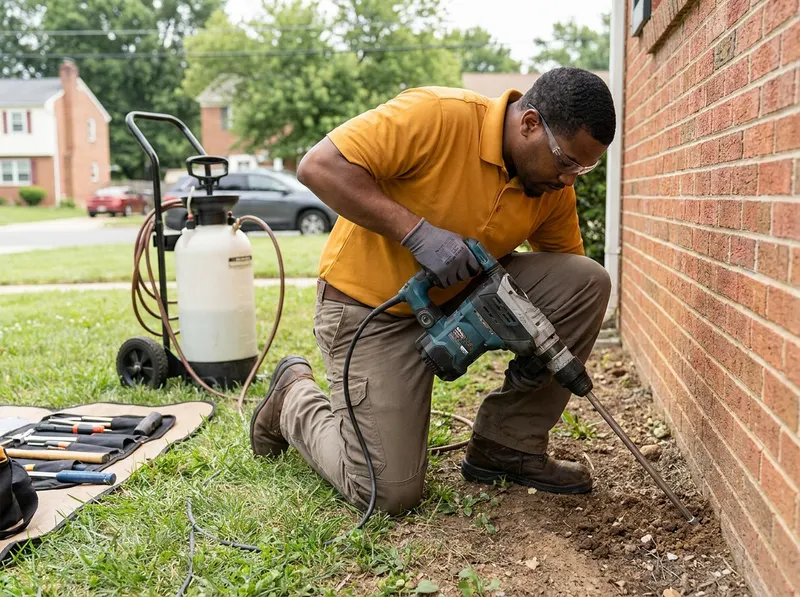
Choosing between methods comes down to how much of the structure is exposed. A localized treatment fits a single, clearly bounded hit — one mud tube climbing a garage wall, a rotted deck ledger, a basement window frame, a porch post set in soil. It costs less and it is honest work when the rest of the foundation walks clean. A full perimeter liquid application fits homes where activity shows in two or more locations, where the mud tubes surface behind a finished basement wall, or where you cannot see enough of the foundation to rule the rest of it out. The trade-off is plain: spot work is cheaper and narrower, and if the colony is foraging along another face of the house, it will simply come up somewhere else. Perimeter work costs more and treats the whole soil line. In-ground bait systems suit properties where trenching is blocked by concrete aprons, tight side yards, or a wellhead-style obstruction, and they suit owners who want ongoing monitoring stations rather than a one-time barrier — they work slower, over months, because the colony has to feed and carry the bait home.
District Heights housing stock pushes the diagnosis in a specific direction. Much of the neighborhood off Marlboro Pike and Donnell Drive is mid-century brick over slab or shallow block foundation, with concrete stoops poured tight against the wall — a classic hidden entry point, because termites travel up the expansion joint where the stoop meets brick and never show a tube outdoors. Sloped lots around Coral Hills and Silver Hill Road bury siding and sill plate lower on the downhill side than the builder intended, and Prince George's County's heavy clay holds water against that wall after a storm. Properties backing the hardwood tree line at Walker Mill Regional Park deal with a steady supply of buried stumps and old root systems within foraging distance. Added-on decks, sheds on skids, and railroad-tie retaining walls across Forestville and Ritchie are the wood-to-soil contacts we find most often. Swarming season here runs roughly late March into May, usually on the first warm, humid afternoons after rain — piles of equal-length discarded wings at a basement window or a sliding door are the single most common reason District Heights homeowners call.
On safety and on the two objections we hear most: every product is applied to its label, and the label governs mixing rate, placement, and re-entry time — we tell you the product name and the re-entry window in writing before work starts, and soil-applied termiticide goes into a trench and back-filled earth rather than living space. For "I already paid someone and they came back," the findings write-up exists precisely for that. If a prior treatment failed, it usually failed at a gap — an untreated stoop, an unaddressed crawl space pier, a bath trap left dry — and naming that gap on paper is the only way you can hold anyone to a fix. We do not require a year-long contract to perform a termite treatment. Annual monitoring is offered, priced separately, and declining it does not change the treatment price. If you are selling or refinancing a District Heights property and a lender wants a wood-destroying insect report, say so when you call so the visit is scheduled for that purpose.
Every job gets a firm, written price after a free on-site visit.
Tell us about your subterranean termite treatment job in District Heights and we'll send a clear, written quote — usually the same day.
 Velora Pest Control Service