Velora Pest Control ServiceVelora Pest Control Service

Pest Inspection and Species Identification

An inspection is worth paying for when nobody has actually named the pest yet. Residents along the Marlboro Pike corridor and in the Donnell Drive apartment blocks often describe "roaches," but the species matters…
Call (227) 269-4830 →(227) 269-4830
Pest Inspection and Species Identification in District Heights, MD
Quick answer
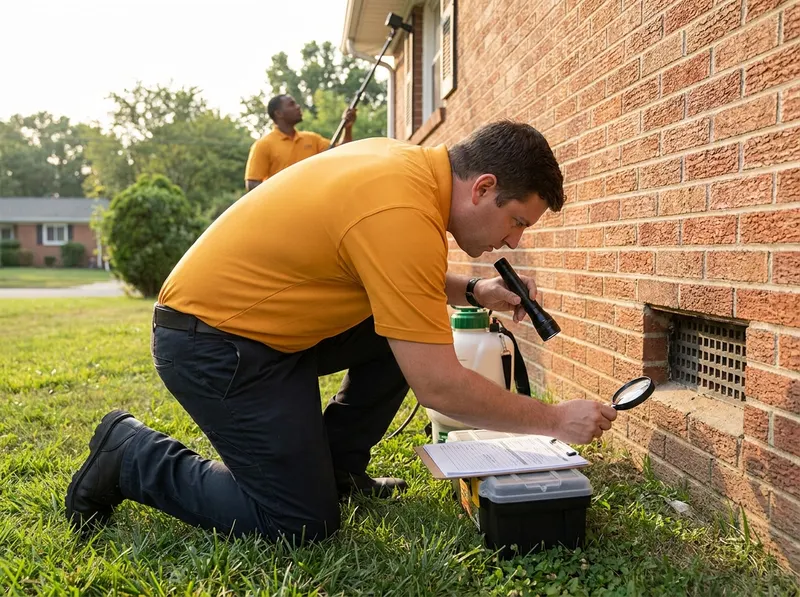
  • What's included: a walk-through of kitchen, baths, basement or slab perimeter, attic access and exterior foundation; species confirmed by specimen, droppings, shed skins or damage pattern; monitors or glue boards placed where activity is suspected; a written findings summary listing entry points, moisture and food sources, and what will bring the pest back.
  • How fast: most District Heights inspections are booked within a few business days, and a standard single-family inspection takes 45 to 90 minutes on site.
  • What it costs: pest inspection and species identification in District Heights starts at a $250 minimum, with larger homes, multi-unit buildings and bed bug or termite-focused inspections running higher.
  • What we take: cash, major credit and debit cards, and standard electronic payment; landlords and small multifamily managers can be invoiced per building.
  • How to book: call (227) 269-4830 with your address and what you have seen — droppings, live insects, bites, wings on a sill — and we schedule the inspection window.

An inspection is worth paying for when nobody has actually named the pest yet. Residents along the Marlboro Pike corridor and in the Donnell Drive apartment blocks often describe "roaches," but the species matters enormously: German cockroaches breed indoors in warm kitchen and bathroom voids and travel between units through plumbing chases and shared walls, while American and smokybrown cockroaches usually wander in from exterior drains, mulch and dumpster areas along the commercial strip. One calls for interior gel baiting and unit-by-unit coordination. The other calls for exterior work and drain and door-sweep corrections. Spraying the wrong one is how people end up paying twice.

The same logic applies to rodents and to bed bugs. In older brick and split-level homes near District Heights Elementary and the Municipal Center area on Marbury Drive, we measure droppings and gnaw marks to separate house mice from Norway rats, because rats need larger exclusion hardware and different bait placement than mice do. On the Walker Mill and Coral Hills side, where yards back up toward the treeline at Walker Mill Regional Park, we check garage thresholds, dryer vents, hose bib gaps and utility penetrations — the openings mice actually use. For suspected bed bugs, especially in rentals near Suitland and around Joint Base Andrews where secondhand furniture and frequent moves are common, we inspect seams, box springs, headboard hardware and baseboard edges for live insects, shed skins and staining rather than guessing from bite marks. Bites alone never confirm bed bugs, and a clean inspection is a real and useful result.

When does an inspection make sense versus just booking treatment? If you have a live specimen in a jar, a clear species, and a small localized problem, going straight to treatment is usually the faster and cheaper path. Choose the inspection first when the problem has already come back after someone else sprayed, when you rent or manage a unit and need documentation of what was found and where, when you suspect termites after seeing wings or a mud tube, or when nobody can agree on what the pest even is. The trade-off is honest: an inspection is a separate visit with its own cost and it does not kill anything that day. What it buys you is a plan aimed at the source instead of a repeat spray schedule.

Prince George's County conditions shape what we look for. Heavy clay soil holds moisture tight against foundations, and slab-on-grade construction is common through Ritchie and the Silver Hill Road area, so subterranean termite inspections focus on slab expansion joints, garage cold joints, sill plates and any mud tubing on interior basement walls. Spring swarms — winged insects at a sunny window sill — are one of the most common reasons District Heights homeowners call, and telling a termite swarmer from a flying ant takes about thirty seconds of close inspection. We give you the findings in writing whether or not you hire us for treatment. That includes photos of what we found, the conditions feeding the problem, and a plain description of what would need to change to keep it from returning.

Multi-unit buildings get a slightly different scope. Where units share walls, we inspect adjoining units when access is granted, because German cockroach and bed bug activity confined to one apartment on paper is rarely confined to one apartment in reality. Owners near Forestville Plaza and Penn Mar Shopping Center commonly need that kind of building-level picture before committing to a treatment budget. Call (227) 269-4830 to describe what you are seeing and we will tell you honestly whether an inspection or a straight treatment visit fits your situation.

What it costs

Standard single-family pest inspection with species ID and written findings (District Heights)$250 – $325
Larger home, finished basement or multi-level inspection$275 – $400
Bed bug–focused inspection (bedrooms and living areas, per unit)$250 – $400
Termite / wood-damaging insect inspection, slab or basement foundation$275 – $425
Rodent entry-point inspection with exclusion punch list$250 – $375
Apartment or small multifamily inspection, per unit (2+ units, same visit)From $250
Follow-up monitor check and re-read after initial inspectionFrom $250

Every job gets a firm, written price after a free on-site visit.

Common questions

How much does a pest inspection cost in District Heights, MD?
Pest inspections in District Heights start at a $250 minimum, and most single-family visits fall between $250 and $400 depending on square footage, foundation type and whether the focus is bed bugs, termites or rodents. These are ballpark ranges — the exact figure is confirmed on site once we see the property. Multi-unit buildings are quoted per unit with a reduced rate for additional units inspected on the same visit.
Will you try to sell me an annual contract after inspecting my District Heights home?
No. A District Heights inspection ends with a written findings summary and options, including one-time treatment where a one-time treatment is genuinely appropriate. Some problems — German cockroaches in a shared-wall building, or an active rodent population with multiple entry points — do need scheduled follow-ups to reach zero, and we will explain why in specific terms rather than defaulting to a year-long plan.
Can you tell the difference between termites and flying ants at my District Heights house?
Yes, and that identification is a routine part of a District Heights inspection. Termite swarmers have straight antennae, a broad waist and two pairs of equal-length wings that shed easily on window sills; flying ants have bent antennae, a pinched waist and unequal wings. We also look for the physical evidence that settles it — mud tubing on foundation walls, hollow-sounding trim, and pinholes in slab expansion joints, all common in the slab-built homes around Ritchie and the Silver Hill Road area.
I rent an apartment on Donnell Drive in District Heights — should I get my own inspection?
A tenant-paid inspection can be useful in District Heights when you need written documentation of what was found before a lease inspection or a conversation with property management. Treatment in a shared-wall building generally has to be coordinated building-wide to work, since German cockroaches and bed bugs travel through plumbing chases and adjoining units. We will inspect your unit, name the species, document conditions, and give you a report you can hand to your landlord.
Do I need to clean or empty cabinets before a District Heights inspection?
No deep cleaning is required for a District Heights inspection visit. Clear access is what helps most: a path to the water heater, electrical panel, sink cabinets and any crawl or attic hatch, and beds accessible on at least one side for bed bug work. Clutter and dishes do not change our assessment, and nothing about the visit involves judgment of your housekeeping — heavy prep, if any is needed, comes later and only for specific treatments.

Ready to get started?

Tell us about your pest inspection and species identification job in District Heights and we'll send a clear, written quote — usually the same day.