Exclusion fits when rodents keep coming back after someone already set traps or bait. If you cleaned out a kitchen drawer of droppings in March and found fresh ones in October, the opening is still there — mice need a…
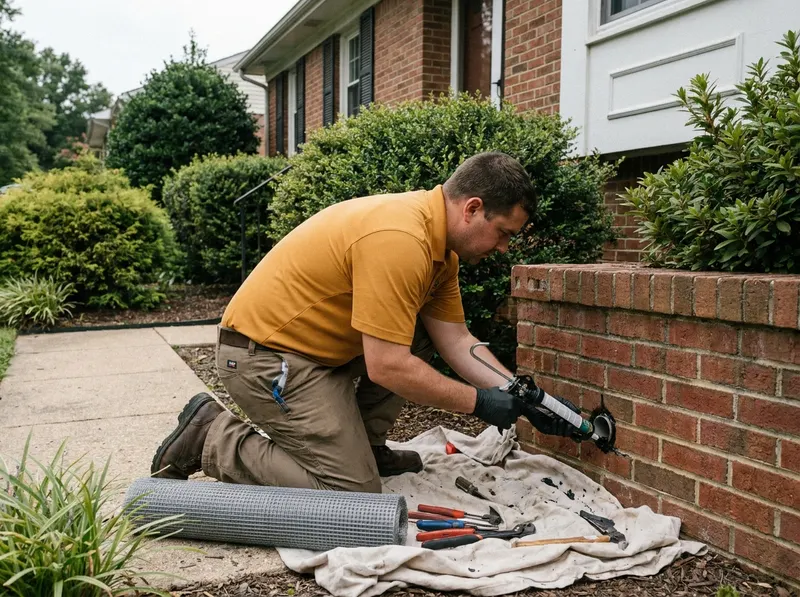
Exclusion fits when rodents keep coming back after someone already set traps or bait. If you cleaned out a kitchen drawer of droppings in March and found fresh ones in October, the opening is still there — mice need a gap about the width of a pencil, and rats need roughly the size of a quarter. The brick and block housing stock around the Marlboro Pike corridor and Coral Hills has predictable weak spots: mortar joints that have crumbled at grade, brick veneer weep openings, and the seam where a later addition meets the original foundation. Homes on crawlspaces off Walker Mill Road commonly have vent screens rusted through or missing entirely, which is a doorway, not a gap. Slab homes push the problem upward instead — dryer vent flaps that no longer close, hose bib and A/C line penetrations, and the two bottom corners of the garage door where the seal has curled away from the concrete.
The alternative is trap-and-bait service on its own, and it is the right choice in one situation: when you need the active population down fast, before anything gets closed up. Sealing a building with rodents still inside pushes them into wall voids and produces odor problems, so we trap first and seal as the population drops. The trade-off runs the other direction too — trapping alone is cheaper per visit but open-ended, because pressure from outside never stops. Properties backing the wooded edge of Walker Mill Regional Park see field mice move toward foundations with the first cold nights, and commercial dumpster areas along Silver Hill Road and the Forestville shopping strips sustain Norway rat activity year-round. Exclusion is the only part of the work that changes the outcome permanently.
Attached and multifamily housing needs a different plan, and we will say so plainly. In the Donnell Drive apartment blocks and in duplexes and rowhome-style units near the Municipal Center on Marbury Drive, rodents travel shared walls, chases and utility runs. Sealing one unit's interior gaps helps that kitchen but relocates the pressure next door. For landlords and property managers we inspect the building envelope as one job — trash enclosures, basement doors, sewer and water penetrations, roof-line soffit returns — and give one findings document you can act on or share with a neighboring owner. If you only control one unit, we will seal what is yours, show you the shared openings we cannot legally touch, and tell you honestly what that will and will not accomplish.
Every job starts with identification. Droppings, rub marks, gnaw patterns and grease trails tell us whether we are dealing with mice or rats and whether entry is at ground level or the roof, and that determines the materials. We do not seal with expanding foam and call it finished; rodents chew through it. Where a hole needs a metal backing, it gets one. You get the findings list, photos of what we found, and re-entry information for any product used near children or pets. Identified first. Treated right. Verified gone.
Every job gets a firm, written price after a free on-site visit.
Tell us about your rodent exclusion and sealing job in District Heights and we'll send a clear, written quote — usually the same day.
 Velora Pest Control Service